Posts

Showing posts with the label CPR

How I schedule classes

Image
Add the subtitle:  and how creating schedules in my house is like herding cats. My instructional business is part-time.  I don't teach full time.  I could try to, but I'm just not sure there is actually enough people out there wanting to take classes to have enough registered participants in each class.  I also like being part-time as I can teach around my family's schedule. And this is where I should put "Cat Herding" on my resume.  Except, we don't own a cat. I usually schedule my classes 3-4 months ahead of time.   Not this time.  Here it is June, and I'm finally posting the summer class schedule.  We were supposed to take a trip, which didn't end up happening.  Then we were signing the kids up for summer camps, looking at creating smaller vacations while college touring all while not knowing which colleges since my oldest has been so busy with school, softball and work that I only see her for short pockets of time - if at al...
Small world

Image
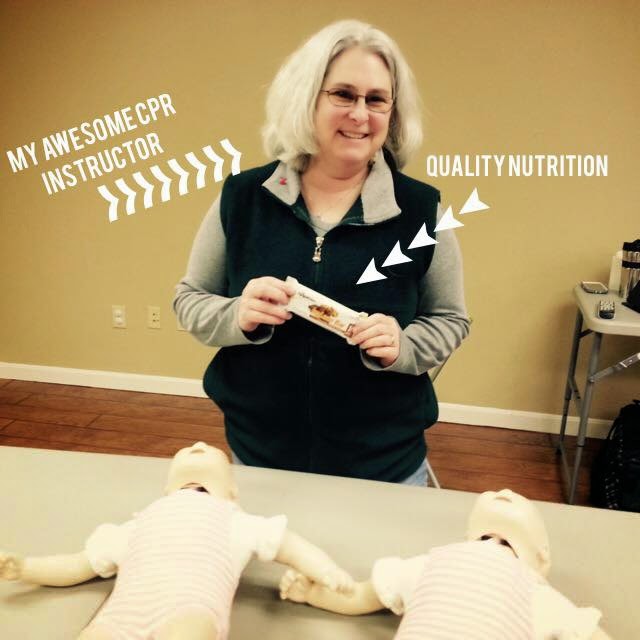
I meet all sorts of really great people in my classes.  At last weekend's CPR by Donation class I met Cindy.  Turns out we have mutual friends and enjoy the same nutritional products!  She took a picture of me with my protein bar. Thanks so much for your kind words!

Weather is not my friend

Image
Last week it snowed.  A lot.  The meteorologist on TV suggested taking 3 measurements in different areas and average them to determine how much snow we received.  In  my yard it ranged from 22" to 27".  No matter how you average it, that's a lot of snow. This is a yardstick stuck in the snow in my yard. This creates an insane amount of havoc on my class schedule.  Last Tuesday I had a class scheduled, which meant I had to reschedule.  One person I tested alone, one switched to a class this upcoming week, the others I have not heard back from.  This is a healthcare provider renewal, so if they need it they'll call or email.  I don't chase people down. This week we're getting snow.  Again.  On Monday.  When I have 3 classes scheduled. {sigh} I just spent 20 minutes figuring out how to fit more classes in over the upcoming week to reschedule all these students.  Normally I can squeeze it in.  But for the last...

Collaboration or Competition?

I attended an AHA Training Center forum a few weeks ago.  I'm always learning something new and the vendors usually have great stuff to share.  :)  I had joined in on a conversation with a few instructors and we realized a few minutes into our discussion that one of them is a local instructor affiliated with a different training center than mine.  She said to me "You're my competitor". Um... what? My first instinct was to say "No, we're colleagues. Not competitors." But it got me thinking afterwards.  Why do instructors, and maybe business owners in general, look at others in their field as competitors?  I've been teaching CPR and First Aid for almost 15 years, 8 of those as a small business.  I've only run across one training center that has been somewhat competitive, undercutting and a little aggressive at times.  I won't name them, that's not fair, but I've had folks in my classes who previously took a class with them and did...

Certification mills vs. blended learning

I read a great article this morning in one of the CPR First Aid Instructor forums I belong to; Unmasking the Certification Mill Problem published in Occupational Health and Safety . This is a topic I'm pretty passionate about. Online-only CPR and First Aid certification websites are scams. They promise "nationally accepted" certification that you take in your home and you can print your card on your own printer. Unfortunately most employers and licensing boards will not accept these cards. Why? Because there is no hands-on component to the course. I did a quick search on my blog and discovered over the past 4 years I've written on this topic a few times. Starting with Online CPR First Aid courses in 2009, I've written Be wary of some online BLS courses , False CPR certification , Video or computer based training versus learning it the old fashioned way , and I received this comment... . On my Coastal CPR & First Aid Blog I've posted What is o...

Yeah, they'll never call back.

Last month I had a phone call I was initially really excited about. It was from an organization that provides training and continuing education resources for childcare providers.  A child care center I had taught CPR & First Aid at referred me to them.  Can I say that I absolutely without a doubt LOVE referrals?  I do, I truly do.  It means I did a good job training their staff and they're not embarrassed to admit I taught them.  Anyway the caller from this organization was thinking of trying someone new to provide classes for them. Sadly I know they will never call me back. I didn't scare them away.  At least I don't think I did.  I told them how long a CPR or First Aid class is and what is covered.  A full class is 6 hours long, but can be broken up into 2 3-hour classes.  A renewal class can be about 4-5 hours long and can also be broken up into 2 classes.  I can do really focused skills-based renewals through the American S...

DNR orders

I had several good questions about DNR aka Do Not Resuscitate orders in some classes a few months ago, and recently there has been a very interesting legal discussion on them in one of the Instructors Forums I belong to. A DNR order is a legal document signed by a patient's physician that states that in the event of a life-ending situation, life-saving measures should not be initiated. This means that CPR is not started. However if someone is choking, and is conscious, you can provide an abdominal or chest thrust to relieve choking. You should not start CPR if the foreign body airway obstruction cannot be removed. You can read the NH Definition of DNR here . How do you know if a person has a DNR? In a medical care facility this will be in the patients chart and paperwork. The nursing and care staff should be familiar with does and does not have a DNR order. In an out-of-hospital setting check to see the patient is wearing a state-issued DNR bracelet or if the family has...

Does it matter whose name is on my card?

Image
I've been following an interesting discussion on an instructors forum I am on. It is one of those conversations that started out as one thing, and is slowly morphing into several different topics. But one of the conversations that came out of it was the staff at one agency somewhat bashing the credentials of another ... and that's not cool. There are many really good CPR and First Aid programs out there. While I teach for the American Heart Association (AHA) and the American Safety and Health Institute (ASHI); there is also the American Red Cross (ARC), Emergency Care & Safety Institute (ECSI), American CPR and probably a few I'm not familiar with. There are also a lot of not so good programs out there, I'm not even going to try to look them up to list them here. How do you tell a good program from a not-so-good program? A good program has a hands-on skills component to the class. A good program can have traditional classroom courses as well as blend...

2010 Guidelines have been released!

Image
The new 2010 CPR Guidelines have been released! I'm still sorting through them but here's the quick list of the changes for layperson rescuers: Adults Determine unresponsiveness and check breathing quickly Send someone to call for help Start compressions.  No breathing first!  Push at least 2 inches on the chest at a rate of 100 compressions per minute. Ratio is 30 compressions and then 2 breaths Use an AED (Automated External Defibrillator) as soon as one is available. Change is the removal of look, listen & feel and the 2 rescue breaths before cycles of compressions begin. Children Determine unresponsiveness and check breathing quickly Send someone to call for help Start compressions.  No breathing first!  Push at least 1/3 the depth of the chest or 2 inches at a rate of 100 compressions per minute. Ratio is 30 compressions and then 2 breaths Use an AED (Automated External Defibrillator) as soon as one is available. Changes: Removal of look, ...

The countdown begins....

Image
Guidelines 2010 will be released in just a few weeks! What are Guidelines 2010? They are changes in how we will perform and teach CPR. Twice a year the International Liason Committee on Resuscitation or ILCOR meets regularly to review scientific studies done on CPR. When there is enough information that suggest that changes should be made they release new guidelines on how we should perform CPR. October 18th is the date the new Guidelines will be released this year. What does this mean if you just took a CPR class? You are still certified in CPR If you have recently taken a class or are planning on taking one before October 18th. Despite releasing the new guidelines on that day, CPR instructors will not have the new training materials until next winter or spring at the earliest. However most of us will be incorporating the new guidelines into our classes until the training materials are available. How do you find out what the changes will be? You can visit this b...

Video (or computer) based training versus learning it the old fashioned way

I'll admit it. I'm a geek. Seriously. I belong to several multiple online groups, where I learn and interact with some great people on topics from work-life balance, work-home balance, business network and yes... CPR and First Aid. Indeed, I have online conversations with people about how we teach CPR. Sounds geeky, but I do learn a lot from these groups! There has been a discussion topic that we keep coming back to; online training. Are DVD's and websites replacing the instructor as the best way to learn CPR? Recently a member of one group posted a link to an article in Resuscitation Volume 81, Issue 8, August 2010, Pages 1004-1009 titled Comparison of instructor-led automated external defibrillation training and three alternative DVD-based training methods . On the edge of your seat wondering the final result of the comparison? Their initial premise was: Self-directed BLS-training, using a personal training manikin with video has been shown to be as ef...

False CPR certification

I saw a link to a news story today .... Firefighter accused of giving false CPR certifications . While it makes me sad in a way I'm not surprised. Occasionally I am asked to do group BLS CPR recert 'session' during employee's lunch hours (so maybe a 30-45 min 'class'). I use the quotes because it really isn't a class, or a session and during an employee's lunch break it just can't easily be done. When you take a CPR or First Aid class it should include hands-on practical skills. In my courses you have to practice and perform all the skills; and for Healthcare Providers you must take and pass the AHA written exam. My goal is to make sure each person in my class can perform the skills as if it was myself or a member of my family you could be saving. How long or how quickly can you learn or recertify in CPR? For Healthcare Providers who are experienced in CPR a renewal session can move very quickly. But you need enough time for each person to de...

How long is a CPR class?

I am often asked how long a CPR class is. Typically they can run anywhere from 2 1/2 to 3 1/2 hours. It depends on the size of the class and the material covered. My classes due to run the full length of time because I like to provide a lot of hands on time and I want to make sure everyone's questions are answered. Some instructors or training sites may list their classes as only 2 hours. My guess is that they have much smaller classes or a lot more CPR equipment than I have. No matter what the length of the course. A good CPR class should have the following components: Hands on practice . Just watching a demonstration of a skill is not the same as learning it. Each participant in the class should have hands on practice time. Questions and answers . If you have a question the instructor should answer it. Keep in mind that while instructors do go through training to teach CPR, we aren't perfect and we don't know the answer to every question that could possibly be as...

Wordless Wednesday 2/3/10

Image
Okay, I'm a day late. But this was too cute to wait until next week. This is of a service dog being taught how to perform CPR.

A really nice email

Today I was going to write about my kids, but then I received this email which I thought was much more important to share: Hi, Gail, Just thought you'd find this interesting... I took your CPR and FA classes in Sept....and in October my husband's life was saved by a bystander who knew CPR (I, of course, wasn't thinking straight, and it never occurred to me that it was a CPR-type situation). The bystander did CPR for about 7 minutes until the ambulance arrived. The EMTs shocked him twice before getting him on the ambulance. It was his heart. He's now fine! You who are and train lifesaving techniques are truly appreciated!! MS This is why I teach CPR and I love to hear that it is used successfully! I am so thankful that her husband is fine and feel honored that several months later she sent this wonderful email. Take care, Gail

Beer keg to heart anatomy and physiology lesson

Borrowed from a CPR instructors group on Google Groups that I belong to: If I want a beer and I pump the keg 5 times and pour 1 lousy beer, the pressure drops back down (G1992) If you and I team up and pump the keg 15 times and pour 2 OK beers, pressure still drops (G2000) If we team up and pump the keg 30 times we get 2 really good beers (G2005) If we pump the keg 50 or 100 times it kills us before we get a beer (50:1 & 100:1 studies) This ends our beer keg to heart anatomy and physiology lesson for today. Interesting analogy on the progression of compressions to ventilation ratios.

What is an AED?

Image
I frequently am asked what an AED is. An AED is abbreviation for an Automated External Defibrillator. An AED is used in conjunction with CPR to try to restart the heart during Cardiac Arrest. Using an AED is very simple. Different models and manufacturers of AED's can look different but they all operate the same way. AED's have voice prompts that will guide you through how to use it, in addition there are step by step directions inside the front cover. The are actually very few steps to operate an AED, but to make it even easier I've broken it down into several steps: Step 1 Turn the AED on. On models with a hard cover the button to open the cover is the on/off switch. On models with a soft cover there will be a green on/off button. Step 2 Take out the package with the AED pads. Open the package and place the pads on the person following the pictures on the back of each pad. Each pad will have a picture of where it should be placed. Please note that the pad must ...

One little thing that makes it all worthwhile

Tonight I had the most wonderful experience. My mom was up visiting and my husband and I decided to go out by ourselves. This alone was a wonderful thing, but the best part of our evening was when we stopped at the supermarket on our way home. We were in the cereal aisle when a woman with a older infant came up the aisle as well. We struck up one of those 'supermarket' conversations about the price of Cheerios when she said that I looked familiar. At first she thought I worked for the local hospital, which I don't, but I mentioned that I taught CPR. Turns out she was in one of my classes almost a year ago. Then she tells me "You saved my daughter's life". Her daughter began to choke on food a few months ago and she successfully performed infant back slaps and chest thrusts to remove the object. Her daughter is almost 13 months old and was happily sitting in the shopping cart smiling at us. We hugged in the aisle. It probably looked odd to anyone els...

Does it take the strength of 10 men?.....

I did a CPR review class recently for the local chapter of Mothers of Multiples. What a fun group! I visited them during one of their meetings to give them the chance to practice their CPR skills and to answer any questions they might have. It wasn't really a class and they had some great questions - some of which I had to really think about! I think it's good to get stumped by questions when I teach, it keeps me on my toes and reminds me why I should be reading all those updates and studies. One of the moms in the group asked me a really interesting question though. She had been told that she was "too small" to do CPR on an adult male. She was rather petite and slender, but I had never heard of anyone being too small to do effective CPR. My immediate reply to her, as a mother of TRIPLETS she probably has more upper body strength than I do! I don't think I could pick up more than 2 kids at a time! But looking at the physics & body chemistry involved in...

The value of CPR & First Aid

Cost of CPR Barrier Sheet: $9.50 Cost of Pocket Mask: $12.25 Cost of CPR course: $40.00 Cost of First Aid Kit: $10.00 Cost of First Aid Course: $40 Knowledge that you can make a difference for someone in an emergency: Priceless In our current economy a lot of us are watching our budgets and trying to get the best value for our money. Taking courses is no exception to that. Prices for CPR and First Aid courses vary depending upon location, who is offering the course, etc. Sometimes I hear that courses are too expensive or I'm asked if discounts are available. So what exactly does the course charge cover and what is the value of knowing CPR and First Aid? First let's take a look at what goes into the cost of a course. I can only speak from my experiences as an American Heart Association Instructor, but the AHA does not set the prices for the courses, it is up to individual instructors to set their own prices. For my business I set up a formula. It is based on a minimum cl...